THE CHIP THAT NEVER SHIPPED
- Codename:
- NV2
- Status:
- CANCELLED → ALIVE
- Year:
- 1996
- Function:
- NVIDIA STOCK DISTRIBUTIONS
THE CAT WHO KEPT
THE PROJECT OPEN
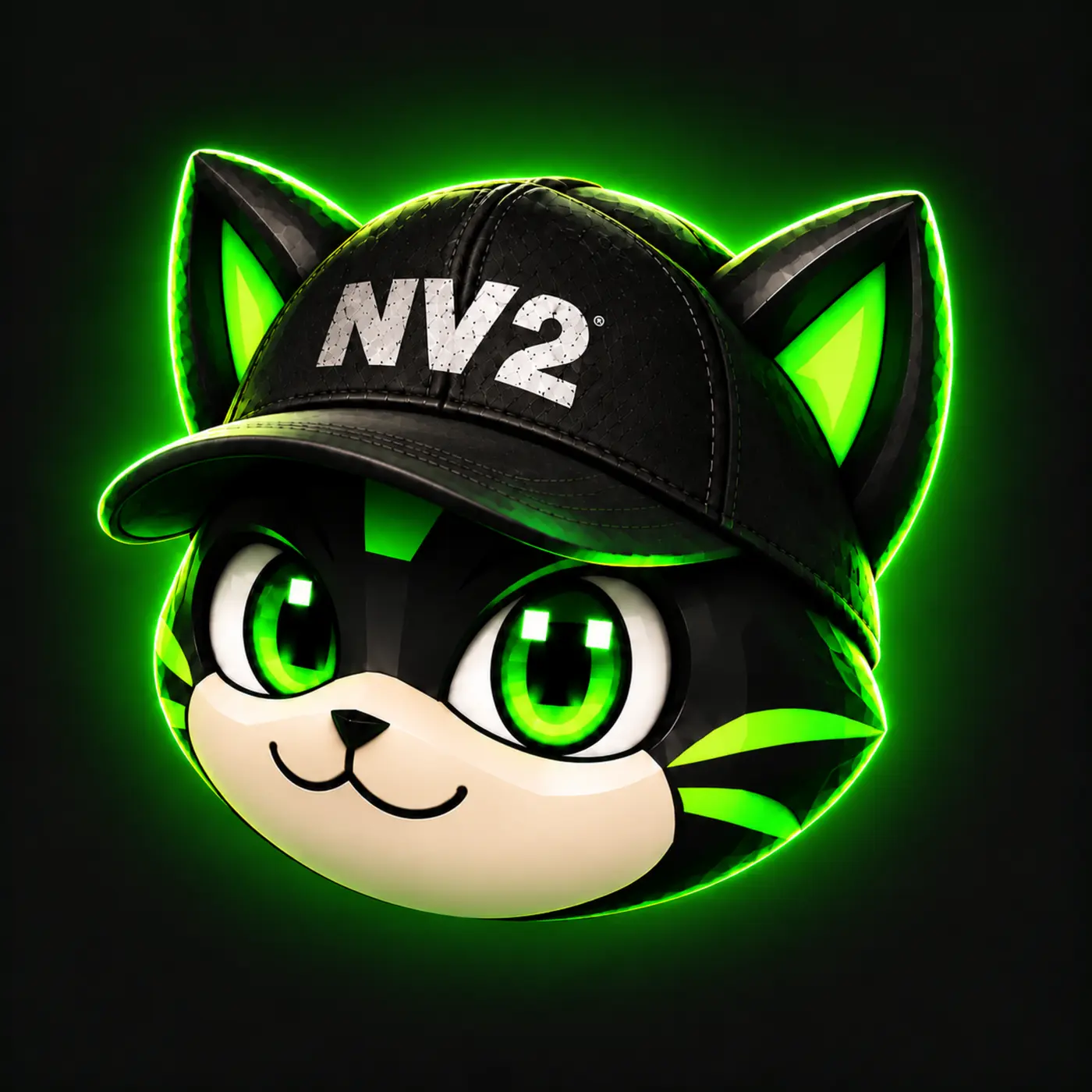
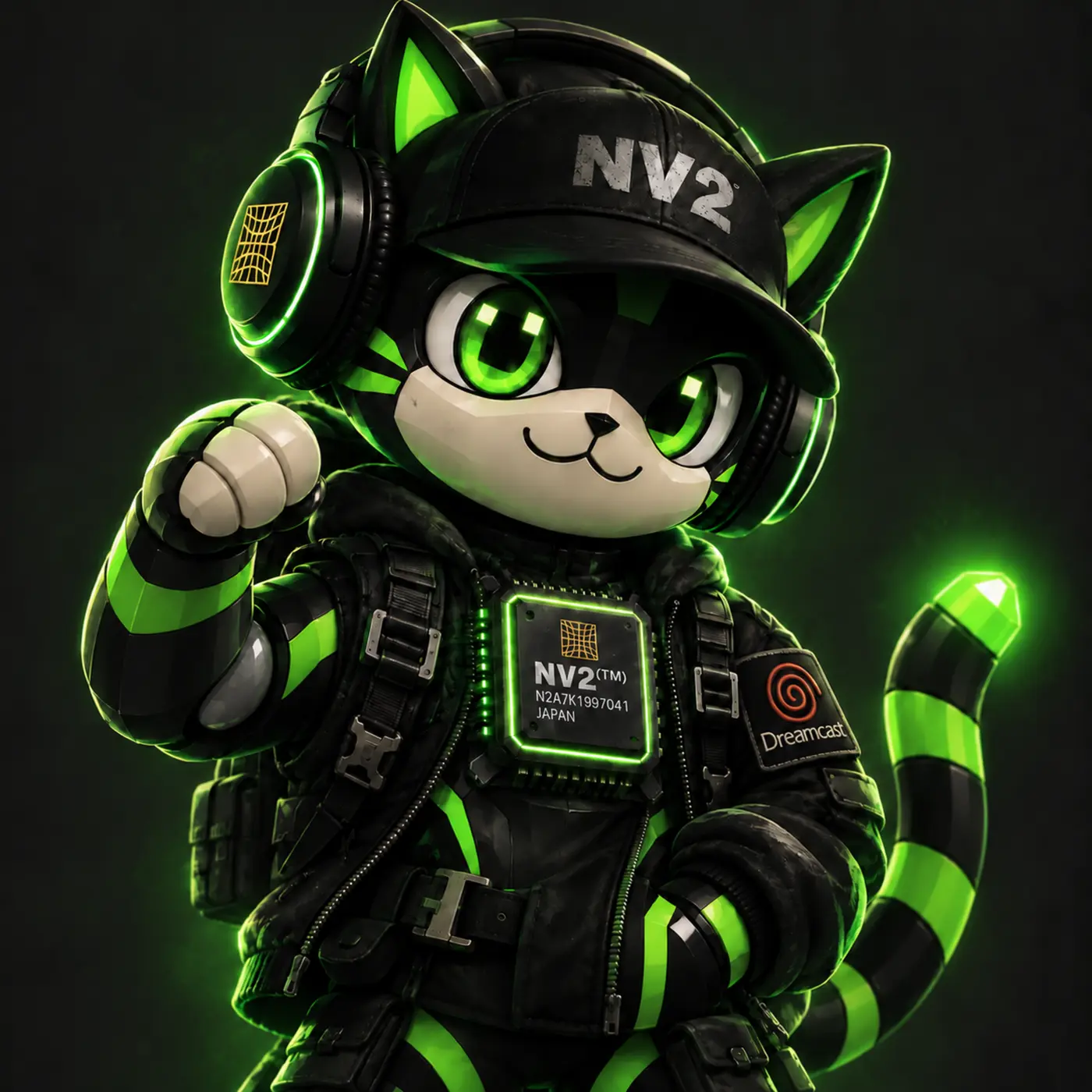
Nekovidia is the mascot NV2 would have shipped with. He is a maneki-neko — the beckoning cat that sits by a shop door and waves customers in, the oldest good-luck charm in consumer electronics. His left paw is raised for a chip that was cancelled before it could be sold to anyone.
He is drawn the way 1996 imagined the future: flat-shaded, visibly polygonal, lit by one hard light and a CRT. The NV2 die sits on his chest as the part he carries rather than the part he runs. He is the project's face because the project has no silicon to show — a mascot is the one deliverable a cancelled chip can still produce.
Nekovidia is project fiction. The chip he carries is not.
A SHORT HISTORY,
THEN A LONG PAUSE
NVIDIA's first product, the NV1, bet on quadratic surfaces instead of the triangles the rest of the industry was converging on. SEGA was an early partner, and NVIDIA began work on a second-generation chip, NV2, intended for SEGA's next console.
The industry moved to triangles. SEGA's hardware direction moved with it. NV2 was cancelled before it reached silicon in any form the public would see, and NVIDIA — a small company with one shipped product — was left without the deal it had been building toward.
By the account NVIDIA's founders have told many times since, SEGA's leadership agreed to pay NVIDIA a multi-million-dollar sum despite the cancelled project. That money is widely credited with keeping the company alive long enough to build the RIVA 128 and the products that followed. The figure repeated in those tellings is five million dollars. NV2 treats that number as its benchmark.
NV2 restarts the project as a market rather than a chip. The development system is switched back on, the project file loads, and the status changes from CANCELLED to ALIVE.
A project once kept alive by a payment to NVIDIA now points value back toward NVIDIA. A percentage of project fees buys NVIDIA stock for distribution to NEKOVIDIA holders. Hold the token, earn the stock.
The original chip
never shipped.
This one does at $100M.
SHIP THE CHIP →
Archive note. The 1995–1996 timeline, the NV1's quadratic approach, SEGA's partnership, the cancellation, and the survival payment are documented history retold from NVIDIA founder interviews and contemporary coverage. Everything on this site labelled STAGE, POST, BUILD, or BIOS is project fiction and should be read as such. Source links belong here once the team finalizes its reading list.
HOLD NEKOVIDIA.
EARN NVIDIA STOCK.
That is the entire machine.
A percentage of project fees is used to purchase NVIDIA stock. That stock is distributed to NEKOVIDIA holders.
HOLD NEKOVIDIA.
EARN NVIDIA STOCK.
No staking. No LP bonding. No second reward token. Holding NEKOVIDIA is the core action.
Nothing on this page guarantees value, price, or return.
In 1996, a payment to NVIDIA kept the company alive. Thirty years later, NEKOVIDIA turns that story around: activity around the cancelled chip now accumulates NVIDIA stock for its holders.
THE NEW LIFELINE SHARES NVIDIA.
THE SIMPLE MACHINE
Market cap advances the project.
Fees buy NVIDIA stock for holders.
- $5M MC
- DREAMCAST ROM BAY
- $100M MC
- SHIP THE CHIP
The holder action is deliberately simple: hold NEKOVIDIA.
PROJECT FEES
└── A PERCENTAGE → NVIDIA STOCK
    └── DISTRIBUTED TO NEKOVIDIA HOLDERS
ACQUIRE NEKOVIDIA
Hold NEKOVIDIA. Earn NVIDIA stock. That simple.
- NETWORK
- —
- PAIR
- —
- MINT
- —
- POOL
- —
FAQ
A meme token built on the story of NVIDIA's cancelled second chip and the payment that helped keep NVIDIA alive.
It was being built for SEGA's next console in 1995–96. The industry moved to triangle rendering, the project was cancelled, and the chip never shipped.
A percentage of project fees is used to buy NVIDIA stock for distribution to NEKOVIDIA holders.
NVIDIA stock.
Hold NEKOVIDIA. There is no staking, LP bonding, points system, or second reward token.
Project activity generates fees. A percentage funds NVIDIA stock purchases, and that stock is distributed to NEKOVIDIA holders.
The original NV2 hardware project never shipped. NV2 turns that history into the project's communal objective. At a $100M market cap, NV2 reaches its final canonical stage: SHIP THE CHIP. It is a project milestone and meme objective, not a prediction.
The Dreamcast ROM Bay unlocks inside the NV2 Development System, allowing users to load their own locally supplied, lawfully obtained Dreamcast game images and BIOS files.
No. $100M completes the original SHIP THE CHIP mission. The project can continue into a post-ship phase.
Market cap only: PROJECT RESTARTED, TAPEOUT ($1M), FIRST SILICON ($2.5M), DREAMCAST ROM BAY ($5M), BOARD ONLINE ($10M), DRIVERS LOADED ($25M), DEV KIT COMPLETE ($50M), SHIP THE CHIP ($100M).
No. Names are used only for historical reference.
A recreated 1996 development system that boots, resumes the project, and displays live project metrics.
Once the $5M market-cap milestone is reached, the Dreamcast ROM Bay accepts bring-your-own, lawfully obtained game images and BIOS files that stay on your device. Saturn support is a future build with no defined milestone yet.
Never. Nothing is uploaded, hosted, proxied, or linked.
On the transparency page, which will list project addresses and distribution records.